
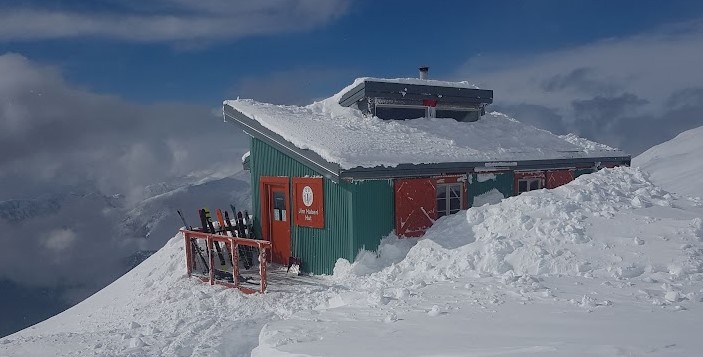
Description
This is a multi-day, heli-supported, hut based, backcountry touring event. It is self-guided with decisions and responsibility shared equally among all participants.
It is the responsibility of each party to have an understanding of the nature and degree of challenge of the terrain, and as a group to be self-sufficient and capable of route finding and travel as well as avalanche rescue and first aid.
Accommodation
4* nights @ Haberl Hut with up to 5* days ski-touring on (easy / moderate to advanced) slopes in the vicinity of Jim Haberl Hut. * (dependent upon prevailing snow and weather conditions at the time). It is important to be aware and accept that Hut fees are totally non-refundable (even if the trip gets cancelled due to flight or avalanche conditions). However for group members who wish, club booking consideration in terms of a rescheduled trip is possible depending upon Hut availability, flying and avalanche conditions
Estimated Hut fees and incidentals $ 200 per person
Food, Cooking and Meals
Evening Meal
HH has limited kitchen amenities and tight cooking quarters. Therefore we suggest that participants form small teams to coordinate and share meal planning and preparation. Ideally 5 teams of 2 would each be responsible for and prepare only a single dinner for 10 people. This arrangement not only minimizes congestion in the kitchen at meal time but it also permits more ski time for those not on KP duty.
Breakfast, Lunch, Snacks and Libations
Participants are responsible for their own breakfast, lunch, snacks and libations.
Emergency (extra) Food (weather risk)
It is sometimes not possible to fly out as scheduled due to prevailing weather conditions. So it is important that participants be prepared for such an unplanned eventuality. We suggest that participants bring a stash of 2 spare days of food rations in case we become cabin bound due to inclement weather.
Ski-touring in the Tantalus Range
This ski-touring event is for experienced, intermediate and better backcountry skiers who have AST 1 or equivalent experience. All participants are required to bring, AVI kit (transceiver, probe & shovel) & crevasse rescue kit: (harness, prusiks, 2 locking carabiners), and expected to be familiar with their deployment and use. Parties venturing out on the slopes must consist of at least 3 people properly equipped, prepared for the terrain & weather conditions, and leave a detailed trip plan in the hut before leaving
Flights In & out
Black Tusk Helicopters allows about 45 lbs of baggage per person….this includes, not only ski’s boots, poles & related gear but also food, sleeping and all other gear.
On average for a group of 10 with skis & winter gear it usually takes about 3 flights of Black Tusk’s A- Star to get everyone and their gear into the Hut.
Flight Costs are estimated to be approximately $ 475 per person
Car pooling
For those coming from the Greater Vancouver area carpooling may be arranged at a mutually convenient location such as St David’s Church @ Upper Levels Highway & Taylor Way enroute to the Black Tusk Terminal @ Squamish Airport.
From Wait List to Participant
Answers to the following questions: – in the “Message to trip Organizer” box when you sign up will be considered in evaluating your suitability for the trip.
What gear do you use Ski Tour, Telemark, Splitboard or Snowboard?
What is your level of training (AST 1, AST2)? Experience?
Do you have a personal (group) First Aid Kit?
Do you have a personal Communication device besides Cell phone, Inreach or similar?
Will you drive a vehicle? How many passengers can you take?
Approximate geographical area where you live? (for carpooling purposes)
Those on the Wait list invited to participate, must e-transfer $ 675 payment before being promoted to Trip Participant (you will be notified of admission by email).
Excess of payments over trip costs will be refunded after all trip bills are paid.
A Group Zoom planning meeting will be arranged for early February to review anticipated weather & snow conditions, necessary avi gear, & meal teams, and address any outstanding issues including communications gear, first aid equipment, carpooling and airport sign in and flight protocols at Black Tusk.
If, a Trip Participant needs to cancel due to an emergency and a suitable replacement from the wait list accepts, a substitution may be allowed.
Please review the Haberl Hut Page on the ACC Vancouver website for additional information related to the Haberl Hut it’s amenities and ACC Vancouver Section policies and practices regarding it’s use occupancy.
Risks and Hazards to be aware of for this event
General Hazards
Slips trips and falls indoor or outdoor. Equipment failure. Infectious disease contracted through viruses, bacteria, parasites, and fungi which may be transmitted through direct or indirect contact. Negligence of other persons on the trip. Negligent first aid. Negligence of other participants including failure to take reasonable steps to safeguard or protect you from, or warn you of risk, dangers, hazards, on participating in ACC activities.
Helicopter
Travel by helicopter over mountainous or alpine environment, includes exposure to risk of helicopter crashes, being struck by rotating helicopter blades and tail rotors, mechanical malfunction of helicopters, and pilot error
Terrain
Risks include but are not limited to Cornices, Crevasses, Cliffs, Creeks, Rocks and Boulders, Holes and depressions below the snow surface, variable and difficult snow conditions impact or collision with other persons, or objects, Loss of balance or control. Becoming lost or separated from the group.
Avalanches
Avalanches can occur in the terrain we will be entering caused by natural forces, or by people travelling through the terrain (skiing/snowboarding). Anyone caught in an avalanche is at risk of personal injury, death, and/or property damage or loss.
Weather
Alpine weather conditions may be extreme and can change rapidly and without warning, resulting in delay in scheduled pick up. Adverse weather may also delay the arrival of treatment and transport out of the field if an injury occurs in challenging terrain movement to an evacuation point may be slow
Communication and Rescue
Communication can be difficult and in the event of an accident, rescue and treatment may not be available.
Boots and Binding systems
Even when set up correctly, a ski binding might not release during every fall or may release unexpectedly. The ski boot/binding system is no guarantee that the skier will not be injured. Non-DINcertified bindings, such as pin/tech bindings, present a higher risk of pre-release and/or injury as they are not designed to the same safety standards as a DIN-certified alpine binding.
Unlike alpine ski boot/binding systems, snowboard and some telemark boot/binding systems are not designed or intended to release and will not release under normal circumstances. Using such a system increases the risk of injury and/or death when caught in an avalanche.
Guest sign-up
Sign-ups are no longer available for this event.